Sweet / Dolce

Saffron panna cotta – Panna cotta allo zafferano

Listen to – Ascolta: Hey! by Suicide Machines

It has been quite some time since my last post and I must apologise with those who read my blog. It’s not that I have not been cooking, quite the opposite, but I’ve been so engrossed in my other hobby that I’ve had little time to sit down to write properly. You see, I sew and during lockdown I’ve decided to move from stuffed toys and accessories to clothing and that took a lot of my spare time!

E’ passato un bel po’ di tempo dal mio ultimo articolo e devo scusarmi con chi legge il blog. Non ho smesso di cucinare, tutt’altro, ma sono stata così impegnata con il mio altro passatempo che ho trovato poco tempo per scrivere come si deve. Vedete, mi piace cucire e durante l’isolamento ho deciso di cimentarmi nel cucire vestiti, dopo aver fatto pupazzi e accessori.

However, there are indeed recipes to share with you! Panna cotta was all the rage during the 90s in Italy, you couldn’t go anywhere without being offered one for dessert. But in time it got heavier and boring, so for a long time, I haven’t been making it. Until I found this recipe and I make it ever since. It’s lighter and aromatic and I am never tired of it.

Tuttavia, ci sono ricette che voglio condividere con voi! La panna cotta era molto in voga negli anni 90 e non potevi andare da nessuna parte senza vedertela offerta come dessert. Ma col tempo diventava sempre più pesante e noiosa, dunque per tanto tempo ho smesso di prepararla. Fino a che non ho trovato questa ricetta e da allora la faccio spesso. E’ leggera e aromatica e non mi stanca mai.

Ingredients for 6 servings / Ingredienti per 6 porzioni:

350 ml double cream / panna liquida

150 ml whole milk / latte intero

80 gr caster sugar / zucchero bianco

20 saffron threads (please do not use the powder!) / pistilli di zafferano (per favore non usate la polvere!)

3 gelatine sheets / fogli di gelatina

Warm up the cream and milk and add the sugar to them. Meanwhile, soak the gelatine sheets in a bowl with cold water.

Continue to simmer cream and milk gently to dissolve the sugar without letting it boil.

Scaldate il latte e la panna e aggiungete lo zucchero. Nel frattempo, ammollate i fogli di gelatina in una ciotola con acqua fredda.

Continuate a scaldare panna e latte a fuoco lento per sciogliere lo zucchero, senza portare a bollore.

Add the saffron to the pan and stir to incorporate.

Aggiungete lo zafferano nel pentolino e mescolate per incorporare.

While stirring, dissolve each gelatine sheet in the pan, ensuring it completely melts.

Continuando a mescolare, sciogliete ogni foglio di gelatina nel pentolino, assicurandovi che sia completamente sciolto.

Strain the mixture and distribute it into small bowls (you should obtain 6 of them). Leave to cool in the fridge for at least 4 hours.

Filtrate il composto e dividetelo in piccole ciotole (dovreste ottenerne 6). Fate raffreddare in frigo per almeno 4 ore.

Decorate as you like before serving. Decorate a piacere prima di servire.

Savoury / Salato

Panzerotti

Listen to – Ascolta: Io non mi sento italiano by Giorgio Gaber

Today, 25th of April, is liberation day in Italy, liberation from nazi-fascism, the end of WWII, 75 years ago. To celebrate it on the blog and at home, today I’ve prepared panzerotti, which are fried calzoni, native of Puglia. They were my grandmother’s speciality and when I think of her, I think of Nonno Carlo, who was anti-fascist, was tortured by the Nazis and escaped only thanks to my great-grandmother, who spoke fluent German and went to rescue him from jail (in Via Piangipane in Ferrara) and it makes me think of my great-grandfather Giacinto, who lost his job due to his integrity and beliefs, as he didn’t want to join the fascist party. Today I thank them for being positive examples to me and I thank those who gave their life to make us free.

Oggi è il 25 Aprile, festa di Liberazione in Italia, liberazione dal nazi-fascismo, fine della seconda Guerra Mondiale, 75 anni fa. Per celebrare a casa e sul blog, oggi ho preparato i panzerotti, nativi della Puglia. Erano la specialità di mia nonna Giulia e quanto penso a lei, penso al Nonno Carlo, antifascista, torturato dai nazisti e salvatosi grazie alla bisnonna Maria, che parlava tedesco e andò a recuperarlo alle carceri in Via Piangipane a Ferrara e mi fa pensare al bisnonno Giacinto, che perse il lavoro per via della sua integrità e credo, perché non volle iscriversi al partito fascista. Oggi li ringrazio per avermi dato il buon esempio e ringrazio chi ha dato la propria vita per renderci liberi.

Back to the recipe, it’s fairly easy, basically a pizza dough, however it gets a bit more complicated in terms of fillings. My grandmother Giulia was from Lucera, which is in the Foggia province. There, the main filling of panzerotti is ricotta cheese with only a little mozzarella: I grew up with it, so I prefer it, but you can use only mozzarella instead, as it’s done in the rest of the Puglia region. My favourite fillings are ricotta, mozzarella and spinach, or ricotta, mozzarella and ham or a simple ricotta, mozzarella and tomato sauce.

Tornando alla ricetta, è abbastanza facile, praticamente impasto della pizza, però diventa complicato in termini di ripieno. Mia nonna Giulia era di Lucera in provincia di Foggia. Lì, il ripieno per i panzerotti è soprattutto ricotta, con poca mozzarella: sono cresciuta mangiandoli così, dunque è la mia preferenza, ma sono buoni anche con la mozzarella soltanto, come è in uso nel resto della regione. I miei ripieni preferiti sono ricotta, mozzarella e spinaci o ricotta, mozzarella e prosciutto cotto, oppure semplici con ricotta, mozzarella e salsa di pomodoro.

I use a round cutter of 10cm diameter and I think it’s the perfect size, I would go larger, as it makes them difficult to fry properly. And yes, Panzerotti are fried, otherwise they are calzoni and it’s a different story!

Io uso un tagliapasta da 10cm di diametro e lo trovo perfetto, sconsiglio di farli più grandi perché diventano scomodi da friggere. E i panzerotti sono fritti, altrimenti si chiamano calzoni e si parla di altro!

Ingredients for 8 panzerotti / Ingredienti per 8 panzerotti:

250gr strong white flour / farina bianca di forza

5 gr dried yeast / lievito secco

1 tsp salt / cucchiaino di sale

1 tbs oil / cucchiaio di olio

100 ml lukewarm water / acqua tiepida

For the filing / per il ripieno:

250gr ricotta, well drained / ricotta, sgocciolata bene

30 gr grated Parmesan / Parmigiano grattugiato

50 gr grated mozzarella / mozzarella grattugiata

a choice of cooked spinach or cubed ham or tomato sauce / a scelta spinaci lessati o prosciutto cotto a cubetti o salsa di pomodoro.

To fry / Per friggere:

500ml sunflower oil / olio di semi di girasole

Mix the flour, oil, yeast and salt, then add the water little by little to form an elastic, non sticky dough. You may not need all the water. Leave to prove until doubled in size.

Mescolate farina, olio, lievito e sale, aggiungete poi l’acqua poco a poco per formare un impasto elastico e non appiccicoso. Potreste non usare tutta l’acqua. Lasciate a lievitare fino al raddoppio.

Get your filling ready: mix the ricotta with the Parmesan and the mozzarella, then add your ingredient of choice, so either mix in the spinach, or the ham or the tomato sauce. But you can get creative and make your own filling as you like it.

Preparate il ripieno: mescolate la ricotta col Parmigiano e la mozzarella, aggiungendo poi il vostro ingrediente a scelta, spinaci o prosciutto cotto o salsa di pomodoro. Potete anche creare il vostro ripieno preferito.

Flour the working surface and roll the dough to about 1 cm thickness, then cut the round shapes.

Infarinate il piano di lavoro e stendete l’impasto a circa 1 cm di spessore, per poi tagliare i cerchi.

Put about 1 tablespoon of filling in the centre, fold in half and seal the edge pressing very well.

Mettete circa un cucchiaio di ripieno al centro, piegate a metà e sigillate bene i bordi premendo bene.

Make sure that the oil is very hot, then fry each panzerotto until golden and crispy. I would recommend to fry maximum two at the same time, to ensure that the oil stays really hot.

Assicuratevi che l’olio sia ben caldo e friggete i panzerotti fino a che sono croccanti e dorati. Non cuocetene più di due alla volta, così che l’olio resti ben caldo.

My Grandmother used to make them thicker and fry them soon long they were almost unhealthy, my version is slightly less greasy, but if you eat them with your hands, they are even more delicious!

Mia nonna lasciava l’impasto più spesso e li friggeva così tanto che erano da infarto, la mia versione è leggermente più sana, ma se li mangiate con le mani, sono ancora più buoni!

Bread / Pane · Savoury / Salato

Taralli pugliesi

Listen to – Ascolta: Just a girl by No Doubt

Although my grandmother came from Puglia, she never made taralli at home, as far as I can remember. But these are a favourite everywhere in Italy, despite being very regional, so I wanted to try and make them at home. They are great with an aperitivo or as a snack and surprisingly easy to make: no proving, just the faff of boiling them before baking, but not that much of an inconvenience.

Sebbene mia nonna fosse pugliese, non ha mai preparato i taralli in casa, che io ricordi. Tuttavia sono amatissimi in tutta Italia, pur essendo una specialità regionale, dunque ho voluto provare a farli a casa. Sono fantastici all’aperitivo o come merenda e sono incredibilmente facili da fare: niente lievitazione, solo la ‘scocciatura’ di lessarli prima di metterli in forno, ma non è così terribile.

You can make them plain, or divide the dough in 3 or 4 parts and add different flavourings to each, which is what I did, adding a couple of spoonfuls of sesame seeds to one part, the same of fennel seeds to another and 4 crushed dried chillies to the other, leaving the fourth one plain.

Potete farli classici, o dividere l’impasto in quattro parti e insaporire ciascuna in modo diverso, che è quello che ho fatto io, aggiungendo un paio di cucchiai di semi di sesamo in una porzione, la stessa quantità di semi di finocchio ad un’altra e 4 peperoncini secchi tritati ad un’altra, lasciando la quarta semplice.

Give them a try, you won’t regret it!

Provate e non ve ne pentirete!

Ingredients / Ingredienti:

500 gr white bread flour / farina bianca per pane

100 ml water / acqua

125 ml dry white wine / vino bianco secco

150 ml olive oil / olio d’oliva

1 tsp salt / cucchiaino di sale

I mixed all the ingredients in a stand mixer to obtain a smooth and greasy dough, you can do this by hand if you prefer. Then divide the dough in four parts and add the flavourings to each, kneading by hand to incorporate them.

Ho mescolato tutti gli ingredienti nella planetaria ad ottenere un’impasto omogeneo e unto, se preferite potete impastare a mano. Dividete poi l’impasto in quattro parti e aggiungete le spezie che preferite in ciascuna parte.

Roll the dough into thin strips (about 1 cm thickness) and cut many pieces of about 5-6 cm, then make a drop shape by sticking the two ends together and press firmly. Continue until you finish the dough.

Formate dei cordoncini con l’impasto (spessore circa 1 cm), rotolandolo sul piano di lavoro e tagliate tanti pezzetti di una lunghezza di 5-6 cm, unite le due estremità a formare una specie di goccia e premete bene per sigillare. Continuate fino ad esaurimento dell’impasto.

Bring a large pan of salted water to the boil, then drop a few taralli in the water and take them out when they come to the surface, leaving them to drain on a rack. Continue until all the taralli are boiled.

Portate ad ebollizione una pentola d’acqua salata e lessate i taralli un po’ alla volta, tirandoli fuori quando vengono a galla e lasciateli asciugare su una griglia. Continuate fino ad aver lessato tutti i taralli.

Turn the oven on at 170 degrees Celsius. Accendete il forno a 170 gradi.

Once the taralli are dry, transfer them on an baking tray, keeping them slightly apart from one another (they will expand while baking). Bake for 40-45 minutes or until golden (the baking time may vary depending on your oven).

Una volta che i taralli sono asciutti, trasferiteli su una teglia da forno, distanziandoli tra loro (si espanderanno in cottura). Cuocete per 40-45 minuti o fino a doratura (il tempo di cottura può variare a seconda del forno).

Savoury / Salato

Pasta con cavolfiore e lardo croccante (Cauliflower and crispy lardo)

Listen to – Ascolta: Take me out by Franz Ferdinand

This pasta is one of the go-to dishes of my aunt Anna, who tells me that it comes from her grandmother, one of my paternal great-grand mothers, Maria. Bisnonna Maria was born in Tarvisio, a small town now in the Friuli Venezia-Giulia region of Italy, on the border with Austria and Slovenia, which was part of the Austro-Hungarian Empire when she was born.

Questa pasta è uno dei piatti forti di mia zia Anna, che mi dice venga dalla sua nonna, una delle mie bisnonne paterne, Maria. La bisnonna Maria era nata a Tarvisio, che oggi si trova in Friuli Venezia-Giulia, al confine con Austria e Slovenia, ma al tempo della sua nascita era parte dell’Impero Austro-Ungarico.

She met my great-grandfather Giacinto, who was from San Ferdinando di Puglia, while he was stationed in Tarvisio as revenue officer, they then moved to Ferrara due to bisnonno Giacinto’s job, who then changed career and became a railway worker, up until the fascists came to power and he refused to join the party and lost his job.

Incontrò il mio bisnonno Giacinto, che era di San Ferdinando di Puglia, perché lui era finanziere di stanza a Tarvisio, si spostarono poi a Ferrara per il lavoro del bisnonno, che cambiò poi carriera per diventare ferroviere, finché rifiutò di iscriversi al partito fascista e perse il lavoro.

So, here’s another bit of my variegated family history and the reason why we cook this dish at home. The funny thing is that I’ve tried to find evidence that this is an actual dish coming from Austro-Hungarian culinary traditions, but I am unable to. I found recipes where there is lardo, but instead of cauliflower they are using cabbage, which indeed would be more in line with the produce of the area. I found, however plenty of evidence for cauliflower pasta in the area of Naples and its region, although not with lardo. Very confusing, a proper mystery!

Dunque ecco un altro tassello della variegata storia della mia famiglia e il motivo per cui cuciniamo questo piatto. La parte divertente è che ho provato a trovare indizi della provenienza di questo piatto dalla zona di origine della bisnonna Maria, ma non ci sono riuscita. Ho trovato ricette con lardo, ma invece del cavolfiore, viene usata la verza, che in effetti è un prodotto più in linea con la zona. Ho trovato tantissime ricette di pasta col cavolfiore dal napoletano e in generale dalla Campania, ma senza lardo. Davvero un mistero!

Regardless, this pasta dish is one of my favourites and it’s so creamy and delicious! In ogni caso, questa pasta è una delle mie preferite ed è cremosa e deliziosa!

Ingredients for 2 portions / Ingredienti per 2 porzioni:

150 gr of cauliflower / cavolfiore

60 gr lardo, thick skin discarded and cubed / lardo, senza la cotenna e tagliato a cubetti

60 gr grated Parmesan / Parmigiano Grattugiato

160 gr of short pasta such as tortiglioni or penne / pasta corta, tortiglioni o penne

1 tbs olive oil / cucchiaio di olio d’oliva

First of all, fry off the lardo in a hot pan with the olive oil, the fat will melt and you will be left with golden, crispy cracklings. Drain them and set aside, keeping the fat in the pan.

Per prima cosa, friggete il lardo in una padella calda con l’olio, il grasso si scioglierà e vi rimarranno i cubetti dorati croccanti. Scolateli e teneteli da parte, lasciando il grasso nella padella.

In a large pot, bring to the boil abundant salted water, divide the cauliflower into florets and leave them to cook for 5 minutes, then add the pasta and let them cook together until the pasta is ready (al dente, so check the cooking time on the packet).

In una pentola capiente, portate ad ebollizione abbondante acqua salata, dividete il cavolfiore nei fioretti e cuocete per circa 5 minuti. Aggiungete la pasta e fate cuocere insieme fino a cottura della pasta.

Drain the cauliflower and the pasta and toss them in the pan with the fat on a medium heat until the cauliflower becomes creamy, then add the Parmesan and continue to toss. Lastly, add the crunchy lard, then serve hot.

Scolate il cavolfiore e la pasta e saltateli nella padella col grasso fino a che il cavolfiore si sfalda e diventa cremoso, aggiungete il Parmigiano e continuate a saltare la pasta. Per ultimo, aggiungete il lardo croccante e servite caldo.

Savoury / Salato

Gnocchi alla romana (semolina gnocchi)

Listen to – Ascolta: All along the watchtower by The Jimi Hendrix Experience

I would like to inform my readers that semolina is not just for puddings or baby food. In Italy is used in a variety of recipes, which although are not local to me, can be quite tasty and I do like to use semolina in my cooking.

Vorrei informare i miei lettori che il semolino non è solo per dessert o cibo da svezzamento. In Italia viene usato in tante ricette, che sebbene non tipiche della mia zona, sono saporite e a me piace usare il semolino in cucina.

One of the recipes I prepare fairly often is gnocchi alla romana. The definition of gnocchi can be quite confusing at times, although it is usually associated with the potato version, which has a defined shape and everybody knows, in reality gnocchi may mean different things: you can have ricotta gnocchi, which are mixed with spinach and plonked in water without shaping (gnudi), squash gnocchi which are prepared similarly to potato gnocchi, and several more!

Una delle ricette che preparo abbastanza spesso sono gli gnocchi alla romana. La definizione di gnocchi può causare confusione, perché sebbene venga associata più frequentemente agli gnocchi di patate, che hanno una forma definita e tutti conoscono, in realtà gnocchi può significare preparazioni diverse: ci sono gli gnocchi di ricotta, mescolata con spinaci e tuffati in acqua senza forma definita (gli nudi), gli gnocchi di zucca, che hanno una preparazione simile a quelli di patate, e tanti altri!

Gnocchi alla romana is possibly one of the simpler and cheaper options and they are fairly quick to make, although you need the semolina mix to cool down and dry out for a while before cooking them. They are typical of Rome and its region, although the controversy is about the use of butter (an ingredient better associated with the north Italy) and Parmigiano rather than Pecorino. Nevertheless, they are delicious!

Gli gnocchi alla romana sono una delle versioni più semplici ed economiche e sono abbastanza veloci da preparare, anche se dovete lasciare il semolino a raffreddare e seccare per un po’, prima di cucinarli. Sono tipici di Roma e del Lazio, anche se c’è un aspetto controverso nell’uso del burro (tipico del nord Italia) e del Parmigiano invece che Pecorino. In ogni caso, sono deliziosi.

Ingredients for 2-4 portions / Ingredienti per 2-4 porzioni:

125 gr semolina / semolino

500 ml full fat milk / latte intero

50 gr grated Parmesan / Parmigiano Reggiano grattugiato

1 egg yolk / tuorlo d’uovo

25 gr butter / burro

ground nutmeg, salt and pepper to taste / noce moscata, sale e pepe a piacere

For the gratin / Per gratinare:

20 gr melted butter / burro fuso

20 gr grated Parmesan / Parmigiano grattugiato

Bring the milk to the boil with salt, pepper and nutmeg. Add the semolina and whisk well to remove any lump. Continue until it thickens.

Portate il latte, con sale, pepe e noce moscata, a bollore. Aggiungete il semolino e mescolate energicamente con la frusta per togliere i grumi. Continuate fino a che il composto non si sarà addensato.

Off the heat, add the butter, the yolk and the Parmesan and mix all together. Then spread evenly on a tray where you have put a sheet of baking paper, to about 1 cm thickness.

Fuori dal fuoco, aggiungete il burro, il tuorlo e il Parmigiano e amalgamate il tutto. Stendete in modo uniforme su un vassoio foderato di carta da forno, ad 1 cm di spessore.

Leave to cool for at least 1 hour, so that it will become compact and easy to handle.

Lasciate raffreddare per almeno un’oretta, cosicché si compatti e diventi facile da maneggiare.

Turn the oven on at 180 degrees Celsius. Accendete il forno a 180 gradi.

With a round cutter, cut the gnocchi (just as they were biscuits) and place in an oven proof roaster (I use a Pyrex glass or Le Creuset ceramic roaster), overlapping each round slightly.

Con un tagliabiscotti rotondo, tagliate gli gnocchi (che somiglieranno a biscotti) e metteteli in una pirofila da forno (io ne ho di vetro della Pyrex o di ceramica di Le Creuset), sovrapponendo i dischi leggermente.

Paint the gnocchi with the melted butter and sprinkle the remaining grated Parmesan all over.

Spennellate gli gnocchi con il burro fuso e spolverateli con il Parmigiano grattugiato rimasto.

Bake in the oven for 15 minutes, then put under the grill for another 5 minutes.

Cuocete in forno per 15 minuti, più altri 5 sotto al grill.

Try them, you’ll like them, I promise.

Provateli, vi piaceranno sicuramente.

Bread / Pane

Ciabatta

Listen to – Ascolta: Il mio nemico by Daniele Silvestri

I don’t often post bread recipes, mainly because I do understand how people would prefer quick and easy recipes and not those where you have to wait too long for an edible result. However, I do bake our bread at home every week and I have reached that level of confidence where I don’t actually follow a recipe, but I mix the ingredients based on experience and taste.

Non pubblico spesso ricette di pane, principalmente perché capisco che chi legge preferisca ricette facili e veloci invece di quelle dove l’attesa per il risultato commestibile sia troppo lunga. Tuttavia, preparo tutte le settimane il pane in casa e ho raggiunto una sicurezza per cui non seguo una ricetta, ma unisco gli ingredienti in base all’esperienza e al gusto.

There are some breads, though, for which I do have to follow the recipes, as the process needs precision and not improvisation. This is one of them. I love ciabatta bread, but most of the recipes I found were quite complicated. This one is from the infallible Paul Hollywood and it does work every time.

Ci sono alcuni pani, però, per i quali devo seguire le ricette, perché il processo richiede precisione e non improvvisazione. Questa è una di esse. Adoro la ciabatta, ma la maggior parte delle ricette che avevo trovato erano davvero complicate. Questa viene dall’infallibile Paul Hollywood e davvero funziona ogni volta.

You will need a squared or rectangular container for proving, quite big, mine is a on plastic with clip-on lid 22x22x12 cm (see proving picture below). It will help you to shape the dough without loosing the all important air bubbles.

Vi servirà un contenitore quadrato o rettangolare per la lievitazione, piuttosto capiente, il mio è di plastica con il coperchio a scatto, 22x22x12 cm (vedi foto della lievitazione, sotto). Vi aiuterà a mantenere la forma senza perdere l’aerazione dell’impasto.

Ingredients / Ingredienti:

500 gr very strong white bread flour / farina di forza per pane, bianca

10 gr salt / sale

10 gr dried yeast / lievito secco per pane

40 ml olive oil (+ 1 tbs to grease the container)/ olio d’oliva (+ 1 cucchiaio per oliare il contenitore)

400 ml lukewarm water / acqua tiepida

Semolina or fine polenta flour for dusting (when shaping) / farina di semola o da polenta fine per spolverizzare (quando si formano le pagnotte)

Thoroughly oil the container, including the sides up to the lid. Oliate bene il contenitore, inclusi i lati fino al coperchio.

Add the flour and the salt in the bowl of a stand mixer, then dissolve the yeast in a little of the warm water and pour it in the bowl, away from the salt. Add the oil and half the remaining water and start to mix with the dough hook, adding the remaining water little by little. Mix for 8-10 minutes to obtain a smooth and elastic dough. You can do this by hand, but this dough is extremely wet and you should not add more flour than required, so it’s very tricky to hand mix!

Versate la farina e il sale nella ciotola dell’impastatrice, sciogliete il lievito in un po’ dell’acqua tiepida e aggiungete alla ciotola, versando lontano dal sale. Aggiungete l’olio e metà dell’acqua rimasta e cominciate ad impastare con il gancio, versando l’acqua rimasta poco a poco. Continuate ad impastare per 8-10 minuti fino ad ottenere un impasto liscio ed elastico. Potreste impastare a mano, ma essendo un impasto estremamente liquido e dato che non dovete aggiungere farina oltre a quella specificata, è estremamente difficile da impastare a mano!

Pour the wet dough into the oiled container, then close the lid. If you don’t have/find a lidded container, you can cover with a towel for proving. Leave to prove at least until doubled. I usually leave it for a couple of hours at least.

Versate l’impasto nel contenitore e chiudete il coperchio. Se non avete/trovate un contenitore col coperchio, potete usare uno strofinaccio per coprire durante la lievitazione. Lasciate lievitare almeno fino al raddoppio. Io lievito per almeno un paio di ore.

Once proven, turn the oven on at 220 degrees Celsius and line two baking trays with baking paper (or use good non-stick baking trays, I find the Circulon brand extremely good).

Una volta lievitato, accendete il forno a 220 gradi e foderate due vassoi da forno con la carta da forno (o usate teglie antiaderenti di buona qualità, per me le migliori sono marca Circulon).

Dust the working surface with plenty of semolina or polenta flour, then tip the dough on the surface with a swift movement, waiting for all the dough to fall down. You will be careful not to handle the dough too much, to avoid losing the air developed during the proving.

Spolverate il piano di lavoro con abbondante farina di semola o di polenta, rovesciate l’impasto dal contenitore con un movimento secco e aspettate che tutto l’impasto sia caduto sul piano. Dovrete cercare di maneggiare l’impasto il meno possibile per non perdere l’areazione sviluppatasi durante la lievitazione.

Sprinkle some more semolina on top of the dough, then cut in 4 strips. If you don’t want the long ciabatta strip, you can cut each strip in half, to obtain what is called zoccoletto.

Spolverizzate la superficie dell’impasto con altra farina di semola, poi tagliate in 4 strisce. Se non vi va la ciabatta lunga, potete tagliare ogni striscia a metà, per ottenere gli zoccoletti.

Carefully place each of the pieces of dough on the tray, be careful as they will still be very wet and difficult to handle: I use a spatula to help me to move them.

Spostate delicatamente i pezzi di impasto sulle teglie da forno, state attenti perché l’impasto sarà ancora estremamente umido, dunque difficile da maneggiare: io uso una spatola per aiutarmi in questo passaggio.

Leave the loafs to prove on the trays for another 20 minutes, then bake for 25 minutes or until golden on top, sounding hollow at the bottom. Leave to cool on a wire rack.

Lasciate le pagnotte a lievitare sulle teglie per altri 20 minuti, poi cuocete in forno per 25 minuti o fino a doratura in superficie. Dovranno suonare vuote sul fondo. Fate raffreddare su una griglia.

Quick&Easy / Facile&Veloce · Savoury / Salato

Carbonara my way / Carbonara a modo mio

Listen to – Ascolta: Out of bounds by No Fun At All

Now, first of all, I am not from Rome, hence this is Carbonara my way. However, there is a rule, which no matter where you are from must be respected, in order to call this a Carbonara: NO CREAM. If you put cream in it (de gustibus…), then you don’t call the dish a Carbonara, simple as that.

Prima di tutto, non sono romana, di conseguenza il titolo carbonara a modo mio. Tuttavia, c’è una regola, che indifferentemente da dove provenite va rispettata, per chiamare questo piatto carbonara: niente panna. Se ci mettete la panna (de gustibus…) allora non la chiamate carbonara, semplice.

Before writing this article, I’ve done some research, as I was expecting to find a registered recipe for Carbonara, however I couldn’t find any. What I’ve learnt, however, is that the origin of the dish is uncertain: some say it’s an evolution of ‘cacio e ova’ (cheese and eggs) a pasta dish that those making charcoal used to consume while waiting for it to be ready. Others say that it came during WWII, when the Americans brought bacon to Italy. Some restaurateurs found an opportunity to create a dish using bacon and eggs. The bacon then has been replaced by ‘guanciale’ which is a cured meat made from pork cheek. I use Italian smoked pancetta (which I do find in British supermarkets) in my version and it’s just as tasty.

Prima di scrivere questo articolo, ho fatto un po’ di ricerche, perché mi aspettavo di trovare una ricetta depositata per la carbonara, tuttavia non ne ho trovato traccia. Quello che ho imparato però, è che l’origine del piatto è incerta: alcuni dicono che è l’evoluzione di ‘cacio e ova’, piatto tipico dei carbonai, che consumavano durante l’attesa che la carbonella fosse pronta. Altri dicono che l’origine risale alla Seconda Guerra Mondiale, quando gli americani portarono il bacon in Italia. Alcuni ristoratori videro un’opportunità per creare un piatto usando bacon e uova. Pare anche che col tempo il bacon sia stato sostituito dal guanciale, prodotto locale nella zona di origine della carbonara. Io uso pancetta affumicata nella mia versione.

And remember that traditionally Carbonara calls for spaghetti, which is a more appropriate type of pasta here, than with ragù! 😉 The rule about the eggs would be to have 1 egg for each serving + 1. I tend to use 1 yolk for each serving, plus one whole egg. I also use a mix of Pecorino and Parmigiano Reggiano cheese, about half and half.

La carbonara si serve tradizionalmente con gli spaghetti, ovviamente. La regola delle uova sarebbe 1 uovo per commensale + 1. Io faccio 1 tuorlo per commensale, più un uovo intero. Inoltre uso un misto di pecorino e Parmigiano, più o meno metà e metà.

Ingredients for 2 servings / Ingredienti per due porzioni:

160gr spaghetti

2 egg yolks / tuorli d’uovo

1 whole egg / uovo intero

50gr smoked pancetta, cubed / pancetta affumicata a cubetti

50gr of grated Pecorino cheese / pecorino grattugiato

50gr of grated Parmigiano Reggiano / Parmigiano grattugiato

a generous grating of pepper (I prefer black) / una generosa grattata di pepe (io lo preferisco nero)

The first thing I do is cook the pancetta in a large pan until golden and crispy, do not rush this and keep the hob to a medium heat. Then set aside.

La prima cosa che faccio è rosolare la pancetta in una padella capiente fino a doratura. Non abbiate fretta e mantenete il fornello a fuoco medio. Lasciate da parte.

Bring the water to a boil in a large pot, add about a handful of rock salt, then drop the spaghetti. Cook to about one minute less than the time on the packet.

While the pasta cooks, beat the eggs and mix with the cheese and pepper. Carefully add about 2 tablespoons of the pasta cooking water and mix. Set aside.

Mentre la pasta cuoce, sbattete le uova e mescolate con il formaggio e il pepe. Aggiungete un paio di cucchiai dell’acqua di cottura della pasta e mescolate. Lasciate a parte.

Drain the spaghetti and add them back to the pan with the pancetta. Bring back to the hob while mixing well. Take off the heat and add the egg mix. Mix well, then serve. More cheese can be added to the plate, if you like.

Scolate gli spaghetti e versateli nella padella con la pancetta, riportandola sul fuoco mentre mescolate bene. Lontano dal fuoco, aggiungete le uova e mescolate bene. Se volete potete aggiungere altro formaggio una volta nei piatti.

As you can see, no need for cream!
Come vedete, la panna non serve!
Savoury / Salato

Risotto al radicchio

Listen to – Ascolta: Red Right Hand by Nick Cave & the Bad Seeds

Following the risotto rice article and the recipe for the Jerusalem artichokes risotto and the one with mushrooms, here is another risotto recipe.

Dopo l’articolo sul riso per risotti e le ricette del risotto coi topinambour e di quello ai funghi, è tempo di preparare un altro risotto.

Returning from Italy after Christmas, we had loads of Italian goodies and amongst them, some radicchio, which we always struggle to find here in the UK. We had some in a salad, but I reserved a little to prepare this delicious risotto: the bitterness of the radicchio marrying so well with the natural sweetness of the rice!

Tornati dall’Italia dopo Natale, abbiamo riportato alcune prelibatezze e tra queste, alcuni cespi di radicchio rosso. Parte è stato mangiato in insalata, ma ne ho conservato un po’ per questo risotto, dove l’amaro del radicchio si sposa con la dolcezza naturale del riso!

Like any other risotto recipe, patience is key, so don’t rush and enjoy the process.

Come ogni ricetta di risotto, la pazienza è fondamentale, dunque niente fretta e divertitevi nella preparazione.

Ingredients for 2 servings / Ingredienti per due porzioni:

5 handfuls of risotto rice / pugnetti di riso da risotto

1/2 onion, finely chopped / cipolla, tritata finemente

10 ml olive oil / olio di oliva

100 ml good quality white wine (or you can use beer, to enhance the bitterness of the radicchio) / vino bianco di buona qualità (o potete usare la birra per esaltare l’amarognolo del radicchio)

1 lt chicken or vegetable stock (or water+stock cube) / brodo di pollo o vegetale (o acqua e dado da brodo)

1 head of red radicchio / cespo di radicchio rosso

30 gr grated Parmesan / Parmigiano grattugiato

Put the oil in a pot and heat it gently. Add the onion and let it sweat. Once it’s translucent, add the rice and warm it up.

Mettete l’olio in pentola e scaldatelo a fuoco dolce. Aggiungete la cipolla e fatela appassire. Quando la cipolla diventa trasparente, aggiungete il riso e tostatelo per qualche minuto.

Add the wine (or the beer) and raise the hob to a medium/low heat, stir gently until the wine has evaporated.

Aggiungete il vino (o la birra) e alzate il fornello a temperatura medio/bassa, mescolate fino a che il vino è evaporato.

At this point, finely chop the white part of the radicchio (the bottom of the head) and add it to the rice. Let it cook for a few minutes, then start adding the stock (or add the stock cube and water), one ladle at time, continue to stir often and add another ladle once the previous has been absorbed.

A questo punto, tritate finemente la parte bianca del radicchio ed aggiungetela al riso. Fatela cuocere qualche minuto e cominciate ad aggiungere il brodo (o il dado e acqua), un mestolo alla volta, continuando a mescolare di frequente e aggiungete il mestolo successivo quando il precedente è stato assorbito.

Continue this way until the rice is cooked. Then add the finely chopped red, leafy part of the radicchio, the grated Parmesan and stir gently to incorporate. Cover the pan for a few minutes to let the risotto rest.

Continuate ad aggiungere il brodo fino a cottura del riso. Poi aggiungete le foglie del radicchio tritate finemente e il Parmigiano grattugiato. Mescolate dolcemente per amalgamare il tutto e lasciate il risotto a mantecare per alcuni minuti coperto.

I hope you’ll like it! Spero vi piacerà!

Savoury / Salato

Risotto with mushrooms – Risotto ai funghi

Listen to – Ascolta: Moving by Supergrass

We talked about the best risotto rice and about the Jerusalem artichokes risotto.

Abbiamo parlato del riso per risotti e della ricetta del risotto coi topinambour.

Now for what is probably my favourite risotto: with mushrooms. I have a soft spot for mushrooms, especially in those recipes where their flavour is enhanced and concentrated. This is one of them!

Passiamo a quello che probabilmente è il mio risotto preferito: coi funghi. A me i funghi piacciono parecchio, specialmente in quelle ricette dove il loro sapore viene esaltato e concentrato. Questa è una di quelle ricette.

Ever since moving to the UK, I’ve struggled to find wild mushrooms which taste would fit well in a risotto. Now I know which mushrooms work best (in my opinion) in a risotto: shiitake. They have a depth of flavour which is perfect in a risotto, much better than any other type I’ve tried.

Da quando ci siamo trasferiti nel Regno Unito, ho faticato a trovare un tipo di funghi che funzionasse bene nel risotto. Al momento i miei preferiti da usare sono i funghi shiitake. Hanno un gusto deciso che trovo perfetto nel risotto, molto meglio di altri funghi che ho provato.

This said, I always and I mean ALWAYS add some re-hydrated porcini mushrooms in my risotto. You can find them in the supermarkets and you simply have to leave them for 10 minutes to soak in hot water, to plump them up. You can then filter the water (as it will have a lovely taste of porcini) to also add to the risotto.

Detto questo, aggiungo SEMPRE porcini secchi al mio risotto. Basta lasciarli reidratare per una decina di minuti in acqua calda. Io uso anche l’acqua in cui riposano (filtrandola) per insaporire ulteriormente il risotto.

Ingredients for 2 servings / Ingredienti per due porzioni:

5 handfuls of risotto rice / pugnetti di riso da risotto

1/2 onion, finely chopped / cipolla, tritata finemente

10 gr butter / burro

100 ml good quality white wine (sometimes I use beer for this risotto) / vino bianco di buona qualità (a volte uso la birra in questo risotto)

1 lt chicken or vegetable stock (or water+stock cube) / brodo di pollo o vegetale (o acqua e dado da brodo)

100 gr shiitake mushrooms, finely chopped / funghi shiitake, tritati finemente

5 gr dried porcini, rehydrated in warm water / porcini secchi reidratati in acqua calda

30 gr grated Parmesan / Parmigiano grattugiato

Put the butter in a pot and melt it at a gentle heat. Add the onion and let it sweat. Add the mushrooms, fresh and dried (which you have rehydrated. Once it’s translucent, add the rice and warm it up.

Mettere il burro in una pentola e fatelo sciogliere dolcemente. Aggiungete la cipolla e fatela appassire. Aggiungete i funghi (sia quelli freschi che quelli secchi reidratati. Quando la cipolla diventa trasparente, aggiungete il riso e tostatelo per qualche minuto.

Add the wine (or the beer) and raise the hob to a medium/low heat, stir gently until the wine has evaporated. If you’ve kept the water from the dried mushrooms, add it to the pan (strain it first).

Aggiungete il vino (o la birra) e alzate il fornello a temperatura medio/bassa, mescolate fino a che il vino è evaporato. Se avete conservato l’acqua dei funghi secchi, aggiungetela alla pentola (ma prima filtratela).

Start adding the stock (or add the stock cube and water), one ladle at time, continue to stir often and add another ladle once the previous has been absorbed.

Cominciate ad aggiungere il brodo (o il dado e acqua), un mestolo alla volta, continuando a mescolare di frequente e aggiungete il mestolo successivo quando il precedente è stato assorbito.

Continue this way until the rice is cooked. Then add the grated Parmesan, stir to melt it and cover for a few minutes to let the risotto rest.

Continuate ad aggiungere il brodo fino a cottura del riso. Aggiungete poi il Parmigiano grattugiato, mescolate per scioglierlo e lasciate il risotto a mantecare per alcuni minuti.

Serve it hot and enjoy! Servitelo caldo e buon appetito!

Savoury / Salato

Risotto ai topinambour – Risotto with Jerusalem artichokes

Listen to – Ascolta: Ghost town by The Specials

So…we talked about the ingredients (here and here), it’s now time to get them together in a mouthwatering dish.

Abbiamo parlato degli ingredienti (qui e qui), è il momento di unirli in un piatto da acquolina in bocca.

When I was little, my parents and I moved a few houses, as they were initially renting. I loved and still cherish my favourite childhood memories from my first house, in Ferrara city centre, Via Muzzina no. 36, however it was when we moved to Mizzana, on the outskirt of Ferrara, that I discovered the pleasure of Jerusalem artichokes. Our house was overlooking the canal (Boicelli) and my dad used to go there with his friends to forage this delicious tubers!

Quando ero piccola, i miei genitori ed io abbiamo cambiato un po’ di case in affitto. La mia casa del cuore, dei miei ricordi più amati, resta quella in centro storico a Ferrara, Via Muzzina numero 36, tuttavia è stato il trasloco a Mizzana, nella periferia nord della città, che mi ha fatto scoprire le delizie dei topinambour. La casa era di fronte al canale Boicelli e il mio papà e i suoi amici andavano spesso in cerca di questi buonissimi tuberi.

It all starts with a very thorough wash and a good old brush, especially if you forage them, your need to clean the Jerusalem artichokes oh so well! Remove all the dirt and soil, then peel them well and wash them again to remove any remaining grit.

Comincia tutto con un lavaggio accurato e una bella spazzolata, particolarmente se li avete raccolti e non comprati, dovete pulire i topinambour molto bene. Rimuovete tutto lo sporco e il terriccio, pelateli bene e lavateli di nuovo per togliere ogni residuo di terra.

I also must say that the rice portions for me are in handfuls, this is how my grandmother taught me and this is how I work. Each portion corresponds to 2 handfuls, however you should always allow some extra (I guess it’s because risotto is so good and you’d always want more!) so it would always be odd numbers of handfuls!

Devo precisare che per valutare le porzioni di riso, io uso sempre le manate, perché questo è quello che mi ha insegnato la mia nonna, dunque così funziona per me. Ogni porzione sono due manate, tuttavia bisogna sempre contare un po’ di extra (penso sia perché il risotto è cosi buono che ne vuoi sempre un po’ di più!, quindi considerate sempre un numero dispari di manate!

Ingredients for 2 portions / Ingredienti for 2 servings:

5 handfuls of rice (Arborio, Carnaroli or Vialone Nano) / manate di riso da risotto

1 knob of butter / noce di burro

1/2 onion, peeled and thinly chopped (I like it red, but any onion or a shallot would do) / cipolla, pelata e tritata finemente (a me piace rossa, ma qualsiasi cipolla va bene o scalogno)

5-6 Jerusalem artichokes, cleaned, peeled and chopped in irregular chunks / topinambour, lavati, pelati e tagliati a pezzetti irregolarmente

100 ml good quality white wine / vino bianco di qualità (non in cartone!)

600 ml good chicken broth (or vegetable) – alternatively you can use a stock cube and water / brodo di pollo (o vegetale) – potete anche usare un dado e acqua

salt to taste / sale a piacere

50gr grated Parmesan / Parmigiano grattugiato

The method is important and should be followed similarly for most of my risotto recipes: melt the butter in the pot and add the finely chopped onions, let them gently sweat. Add the Jerusalem artichokes and let them simmer for a couple of minutes. The hob should be constantly on a medium heat.

Il metodo è importante e dovrebbe essere seguito per la maggior parte dei miei risotti: sciogliete il burro e aggiungete le cipolle, lasciandole appassire. Aggiungete i topinambour e fateli sobbollire per un paio di minuti. Il fornello deve rimanere sempre a fuoco medio.

Add the rice and mix it with the vegetables. The rice MUST toast for a few minutes to absorb the flavours, the trick is to touch the rice with your finger, if it’s hot, then it’s time to add the wine. Pour the wine in and stir well.

Aggiungete il riso nella pentola e mescolate bene. Il riso DEVE tostarsi per alcuni minuti per assorbire i sapori, il trucco è di toccare il riso con un dito, se scotta, è il momento di aggiungere il vino. Versatelo in pentola e mescolate bene.

Keep stirring regularly until the wine is absorbed. Just before the rice starts to stick to the pot, add a ladle of stock (or add the stock cube and a ladle of hot water). Stir again regularly until the liquid is absorbed, add another ladle of liquid and continue this way until the rice is cooked.

Continuate a mescolare regolarmente fino a che il vino si è assorbito. Appena prima che il riso si attacchi alla pentola, aggiungete un mestolo di brodo (o il dado e un mestolo di acqua calda). Mescolate ancora regolarmente fino a che il liquido è assorbito, aggiungete un altro mestolo e continuate fino a che il riso è cotto.

Take off the heat, add the grated Parmesan and stir to melt it. Taste the risotto and add salt if necessary. Cover with a lid and let it rest for about 5 minutes: this is what we called ‘mantecare’ in Italian. Serve the rice while warm and add more Parmesan to taste.

Togliete dal fornello e assaggiate, aggiungete il Parmigiano grattugiato e mescolate per scioglierlo. Assaggiate e regolate di sale se necessario. Coprite con il coperchio e fate mantecare per 5 minuti. Servite il riso ancora caldo e aggiungete Parmigiano a piacere.

Ingredients / Ingredienti

Let’s talk about RISOTTO

Risotto is one of my go-to dishes, firstly because it’s quite therapeutic to cook, secondly because it’s one of the first dishes that my grandmother Lella taught me, thirdly, because I love it!

I risotti sono una dei miei primi preferiti, prima di tutto perché li trovo terapeutici da preparare, con calma e con cura, in secondo luogo perché sono uno dei piatti che la mia nonna Lella mi ha insegnato a preparare ed infine perché li adoro.

Now, regardless to what some chefs would tell you, in Italy, you don’t mess about with risotto, it’s an art and you cook it as tradition tells you!

Non mi interessa cosa dicono gli chef moderni, il risotto è un’arte e si cucina come da tradizione!

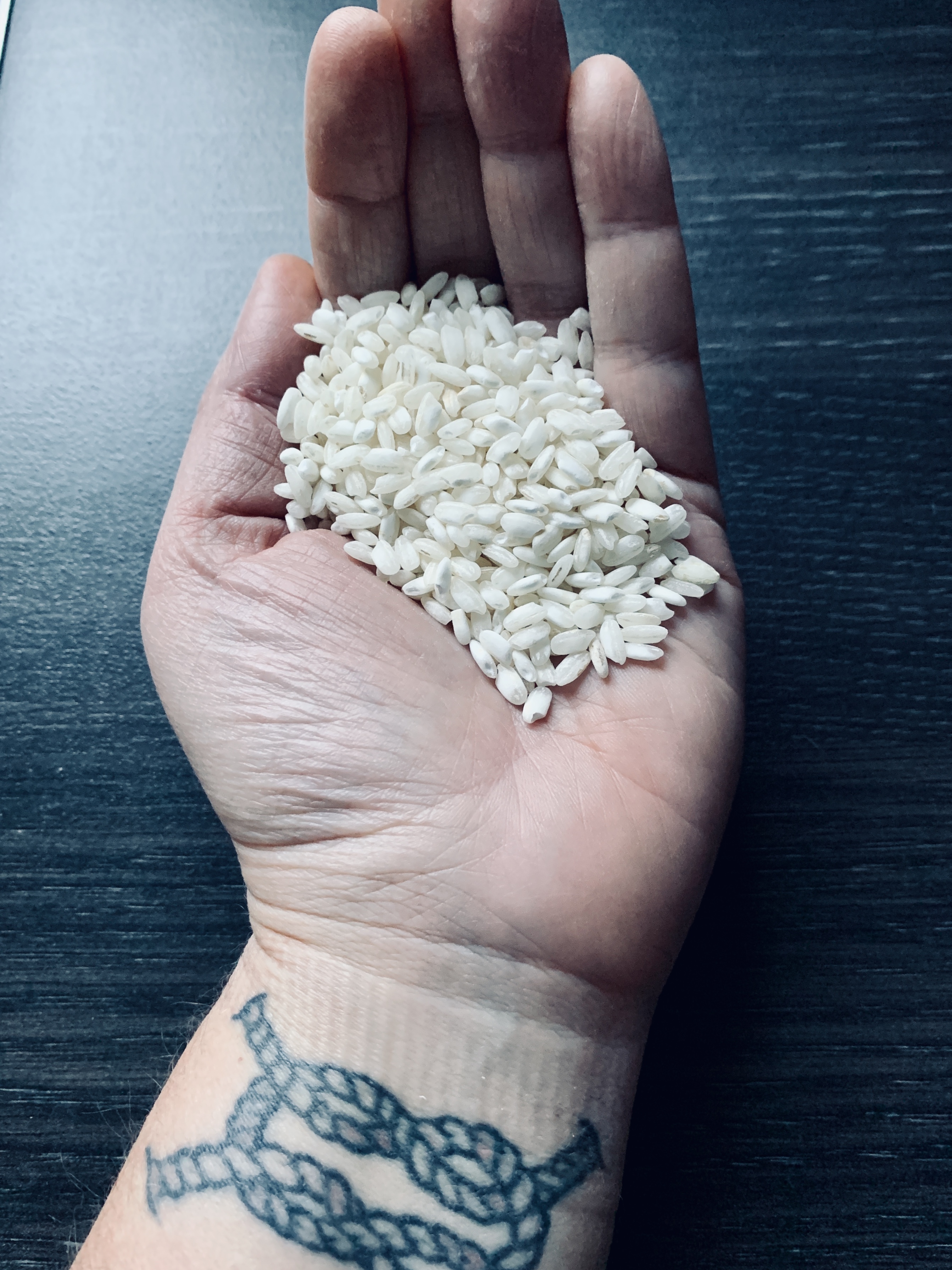
We use three main types of risotto: Carnaroli, Arborio and Vialone Nano, the latter practically impossible to find in the UK, unfortunately, but one of the most used in my region, Emilia-Romagna. The type of rice is fundamental and all the above are rich in starch, which makes for a creamy risotto.

In Italia le qualità di riso più usate sono: Carnaroli, Arborio e Vialone Nano, quest ultimo praticamente introvabile in Regno Unito purtroppo, ma uno dei più usati in Emilia-Romagna, in quanto ampiamente coltivatovi. Il tipo di riso è fondamentale e le qualità di cui sopra sono ricche di amido, ideali per un risotto cremoso.

The other important element to a good risotto is the alcohol. Most risotto recipes call for white wine and you would use red wine on a handful of them (on top of my head I can think of risotto alla pilota, which is made with sausages). To be honest, sometimes I use beer instead of white wine, as I like the slightly bitter accent it gives to some of the ingredients.

L’altro importante elemento per un buon risotto è l’alcool. La maggior parte delle ricette per risotti utilizzano vino bianco e il rosso si usa per pochi risotti (mi viene in mente il risotto alla pilota, con le salsicce o comunque di carne (braciole o puntarelle, a seconda della ricetta). Qualche volta, a seconda degli ingredienti, uso la birra al posto del vino, perché mi piace quella punta di amarognolo.

A good risotto starts with a soffritto made with vegetables. I use onions or shallots most of the times, which go with most risotto recipes (asparagus, courgettes, saffron, aubergines, etc). Sometimes I use garlic instead, especially with mushrooms risotto or seafood.

Un buon risotto inizia dal soffritto di verdure. A me piace usare principalmente cipolle o scalogna, che si adattano alla maggioranza delle ricette (di asparagi, di zucchine, allo zafferano, con le melanzane, ecc). A volte uso l’aglio, particolarmente per il risotto di funghi o di pesce.

Finally, the secret of the best risotto, is patience. You need to wait for each of the ladles of liquid to be absorbed before adding the next, you need to stir it with love, to let the starch out in the sauce, you need to taste it and love it, little by little.

Infine, il segreto per il miglior risotto è la pazienza. Bisogna aspettare che ogni mestolo di liquido sia assorbito, prima di aggiungere il successivo, bisogna mescolare con amore, per estrarre l’amido dal riso, devi assaggiarlo e amarlo, poco a poco.

I will share my risotto recipes in this blog, however I felt that I needed first to explain what a risotto is about, not rushing, choosing the right ingredients, having patience.

Condividerò le mie ricette per risotti in questo blog, tuttavia dovevo prima spiegare cosa fa un risotto, la calma, la scelta degli ingredienti giusti e la pazienza.

Sweet / Dolce

Fave dei morti – an Italian Halloween recipe

Listen to – Ascolta: This is Halloween from The Nightmare Before Christmas (Denny Elfman)

Halloween is not exactly an Italian celebration, given the more religiously inspired festivities which are typical of the catholic influence, however you can find ancient recipes related to All Souls’ Day, which is the 2nd of November.

Halloween non è propriamente una festività sentita in Italia, dove si seguono principalmente festività religiose a causa dell’influenza cattolica; tuttavia esistono ricette tradizionali legate al giorno dei Morti.

These little almond biscuits were traditionally left for the deaths who come back to visit their families, to sweeten their mood. The recipe is similar throughout Italy, however the shape and appearance may vary, in my region the biscuits are of different colours and flavours.

Questi biscottini alle mandorle per tradizione venivano lasciati per i morti che tornavano a visitare le loro famiglie, per addolcirne l’umore. La ricetta si trova simile in molte regioni italiane mentre la forma e l’aspetto possono variare, nella mia regione i biscotti hanno colori e gusti diversi.

The best option is to make a big batch of plain dough, then divide it in as many bowl as the flavours you wish to use. To distinguish the different flavours, add a little food colouring to each bowl.

La migliore soluzione è preparare l’impasto base, dividendolo poi in tante ciotole quanti sono i gusti che volete utilizzare. Per distinguere i diversi gusti, aggiungete un po’ di colorante alimentare a ciascuna ciotola.

For the dough (makes about 100 tiny or 50 bigger biscuits) / per l’impasto (per 100 biscottini o 50 se più grandi):

200 gr finely grounded almonds / farina di mandorle

100 gr plain flour / farina bianca

90 gr caster sugar / zucchero bianco

1 egg / uovo

25 gr softened butter / burro ammorbidito

Mix all the ingredients together to obtain a soft, pliable dough. Mescolate tutti gli ingredienti fino ad ottenere un impasto morbido e malleabile.

Divide it in 3 or 4 bowls. Dividetelo in 3 o 4 ciotole.

Now for the flavourings / Per i gusti:

1 tablespoon of cocoa powder / cucchiaio di cacao amaro in polvere

1 lemon zest, grated / la scorza grattugiata di un limone

1 tablespoon of Amaretto liqueur / cucchiaio di Amaretto di Saronno

1 teaspoon of vanilla paste / cucchiaino di pasta di vaniglia

Mix in the different flavourings with every bowl. You may need to add a little milk to the cocoa dough, as it may be too dry to work with.

I also added a bit of pink colouring with the Amaretto and some green with the vanilla.

Mescolate uno dei gusti in ciascuna ciotola. Potrebbe servire un po’ di latte per l’impasto al cacao, per evitare che si secchi troppo e diventi difficile da lavorare.

Ho anche aggiunto il colorante rosa al gusto Amaretto e un po’ di verde al gusto vaniglia.

Roll each dough into a long strip and cut the biscuits either the size of your thumbnail or double.

Formate tanti rotoli con ciascun impasto e tagliate i biscotti della dimensione dell’unghia del pollice o il doppio.

Bake in a pre-heated oven at 180 degrees celsius for about 12 minutes, then cool on a rack.

Cuocete in forno pre-riscaldato a 180 gradi per circa 12 minuti e fate raffreddare su una griglia.

These biscuits will last for at least a week in an airtight container, but don’t forget to leave some out on the 2nd November! 😉

Questi biscotti dureranno almeno una settimana in una scatola di latta, ma non dimenticate di lasciarne qualcuno per i visitatori il 2 di novembre! 😉

Savoury / Salato

Bolognese? Please call it ragù

Listen to – Ascolta: Eptadone by Skiantos

The pasta sauce commonly know as ‘Bolognese’ in English speaking countries, in Italy is known as ragù, a word derived from the French. Ragù is typical of my region, Emilia-Romagna and although there is a certified recipe to prepare it, in reality every household has its own.

Il ragù è comunemente conosciuto come ‘bolognese’ nei paesi di lingua inglese, tuttavia da ferrarese, pur riconoscendone la provenienza originaria, non posso fare a meno di precisare che in realtà è un sugo tipico dell’intera Emilia-Romagna e anche se esiste la ricetta depositata ogni famiglia ha la sua versione.

Mine is an adaptation of my grandmother Lella’s recipe, which I changed to my taste (she doesn’t like it too tomatoey, but I do!).

La mia è adattata da quella di mia nonna Lella, che ho cambiato leggermente secondo il mio gusto, dato che a lei piace più pallido, mentre a me piace con molto pomodoro.

Ragù is one of my favourite sauces and is also quite versatile: of course its common use is with pasta (preferably tagliatelle, but it works with shorter pasta such as penne but NO, NOT WITH SPAGHETTI!) and you would use it for lasagne, but I also use it with polenta to make it ‘pasticciata’ (messy). I will talk more about polenta in another post, maybe.

Il ragù è uno dei miei condimenti preferiti per la pasta, ma non solo: lo uso spesso sulla polenta per farla pasticciata, ma potrò parlare di polenta in un altro articolo.

What I tend to do, given how long a good ragù should cook for, is to prepare a large quantity and freeze it: ragù freezes very well and in my family we keep it in the small Nutella glasses which are perfect for portions (each would keep about 200gr) and stacking!

In genere preparo una bella quantità di ragù, dato il tempo di preparazione e cottura e poi congelo, usando – come da tradizione di famiglia – i bicchieri della Nutella, che offrono porzioni perfette (circa 200 gr) e si impilano bellamente in freezer.

The rule for ragù is be patient and do not rush it! The sauce needs its time to absorb the liquids and the flavours.

La mia regola per il ragù, ma non devo spiegarla agli italiani, è di avere pazienza e non affrettare la cottura, il sugo ha bisogno di tempo per assorbire i liquidi e i sapori.

Ingredients for about 2kg of ragù (12 Nutella glasses) / ingredienti per circa 2 kg di ragù (12 bicchieri da Nutella)

You will need a rather large pot. Vi servirà una pentola capiente.

500 gr good quality pork mince / macinato di maiale di buona qualità

500 gr good quality beef mince / macinato di manzo di buona qualità

1 l tomato sauce / passata di pomodoro

400 ml good quality red wine (my rule is ‘if you won’t drink it, don’t cook with it’) / vino rosso di buona qualità (la mia regola è ‘Se non lo berresti, non usarlo in cucina’)

4 medium sized carrots, finely diced / carote medie tritate finemente

4 medium sized celery stalks, finely diced / coste di sedano medie, tritate finemente

1 red onion, finely diced / cipolla rossa tritata finemente

2 tbs olive oil / cucchiai di olio d’oliva

I also use one chicken stock cube, then check the salt towards the end of the cooking and add if necessary.

Io uso anche un dado da brodo di pollo, regolando di sale a fine cottura, se necessario.

Pour the oil in the pot and turn the hob on to a medium heat. Add the chopped vegetables and let them simmer in the oil until they are translucent.

Versate l’olio in pentola e accendete il fornello a calore medio. Aggiungete le verdure tritate e lasciate appassire fino a che saranno trasparenti.

Add the meat and let it brown gently, turning it often for an even colour. Aggiungete la carne e fatela rosolare girandola spesso in modo che sia uniforme.

Add the red wine and let it absorb almost completely, keeping the heat constant. Aggiungete il vino e lasciatelo assorbire quasi totalmente, mantenendo il fornello costante.

Now add the tomato sauce and the stock cube, mix well and continue to cook at a medium heat, stirring every now and again. Aggiungete ora la passata e il dado e continuate a cuocere a fuoco medio, mescolando di tanto in tanto.

When the sauce looks reduced, check if you need to add more salt, if you do, let it simmer for a few more minutes. Quando il sugo è quasi pronto, regolate di sale se necessario e lasciate sobbollire per alcuni minuti in più.

The ragù will be ready once most of the moisture is absorbed, but the sauce still looks creamy: it will take 3 to 5 hours, depending on how moist are your meat and vegetables.

Il ragù sarà cotto quando il liquido è quasi totalmente assorbito, ma il sugo rimane cremoso: ci vorranno dalle 3 alle 5 ore, a seconda di quanto acquose sono le verdure e la carne.

Once the sauce is cold, pour it into containers (or Nutella glasses) and freeze it, or use it immediately in your lasagne!

Una volta freddo, versatelo in contenitori (o nei bicchieri della Nutella) e congelatelo, o usatelo subito per le lasagne!

Quick&Easy / Facile&Veloce · Savoury / Salato

Pasta con la bottarga

Listen to – Ascolta: Prince charming by Adam & The Ants

One of the great things about Italian cuisine, is that many recipes are so simple! With few, right ingredients, you can sort out lunch in no time.

Una delle particolarità della cucina italiana è che molte ricette sono semplicissime. Con pochi ingredienti, si organizza il pranzo in pochi minuti.

Amongst the ingredients that I always keep in my larder and are perfect for a quick and easy meal are: cherry tomatoes, anchovies, capers, pine nuts, basil, breadcrumbs, tinned tuna and bottarga.

Nella mia dispensa, pronti per un piatto facile e veloce, non mancano mai pomodorini, acciughe, capperi, pinoli, basilico, pangrattato, tonno in scatola e bottarga.

Bottarga is dried fish roe and can be found in a big solid slab or already grated. It’s very popular in Italy, particularly in Sicily and Sardinia, but widely used throughout the country.

La bottarga è prodotta dalla sacca di uova di pesce essiccata e si compra intera oppure già grattata. È molto popolare in Italia, soprattutto in Sicilia e Sardegna, ma si usa nel resto della Penisola.

For this recipe you need 4, maximum 5 ingredients: spaghetti (but any long pasta would work, in picture you’ll see Trenette), good extra virgin olive oil, breadcrumbs and bottarga. If you want to, a clove of garlic to flavour the oil.

Per questa ricetta bastano 4 o 5 ingredienti: spaghetti (o altra pasta lunga, in foto vedete delle Trenette), olio extra vergine d’oliva, pangrattato e bottarga. Se volete, uno spicchio d’aglio per insaporire l’olio.

How?

Leave the clove of garlic in the cold oil to infuse for about 30 minutes. Toast the breadcrumbs in a pan and set aside for later. Cook the pasta in salted, boiling water. Do not overcook it, different sizes of spaghetti have different cooking times:

N. 5: 9 minutes

N. 3: 5 minutes.

I don’t want to sound patronising to the Brits or other non-Italian reading this blog, but please, read the cooking time on the package, you’ll find out how well cooked pasta taste like 😉

Drain the pasta and pour it in the oil, toss well. Add the bottarga (For 2 people, use about 1 teaspoon of powder) and toss again. Plate up and scatter the breadcrumbs on top. If you like it (6th ingredient!) add some chilli flakes.

Enjoy!

Come la preparo io?

Lasciate lo spicchio d’aglio ad insaporire l’olio a crudo per una mezz’oretta. Tostate il pangrattato in padella e mettete da parte. Cuocete la pasta (ho scritto istruzioni dettagliate per i non-Italiani, ma voi non ne avete bisogno!).

Scolate la pasta e conditela con l’olio, mescolando bene. Aggiungete la bottarga in polvere (io metto un cucchiaino per due persone) e mescolate di nuovo. Servite nei piatti con una bella spolverata di pangrattato e, se vi piace, (sesto ingrediente!) un po’ di peperoncini sbriciolati.

Buon appetito!

Savoury / Salato

Ruota di focaccia pugliese

Listen to – Ascolta: Rise&Shine by Cardigans

So, I indeed am from the north of Italy, however my paternal grandmother is from Puglia and, oh boy, don’t they also know how to cook!

Dunque, io sono decisamente del nord Italia, ma mia nonna paterna viene dalla Puglia e anche loro cucinano niente male!

Whenever I was visiting her house (and my beloved grandad, Nonno Carlo), Nonna Giulia had something delicious going on, either focaccia, or panzerotti, or trocchioli with ragù di braciole pugliese (actually, Nonno Carlo made that better, although he was from Ferrara!). And yes, many of those recipes will feature on this blog.

Ogni volta che andavo a trovarla (e con lei il mio adorato Nonno Carlo), Nonna Giulia aveva qualcosa di delizioso pronto, a volte la focaccia, o i panzerotti o i trocchioli con il ragù di braciole pugliese (anche se in realtà il Nonno Carlo lo faceva meglio, pur essendo ferrarese!). E, sì, molte di quelle ricette appariranno sul blog.

Nonna Giulia is still with us, however she is now 94 and not really fit for cooking anymore. So, I got her recipe and it’s now one of my best acts.

La Nonna Giulia è ancora con noi, ma a 94 anni non cucina più. Quindi, ho carpito la sua ricetta e ora è uno dei miei pezzi forti.

The secret to this soft, plump focaccia is…(drumroll): boiled potatoes!

Il segreto di questa focaccia soffice e gonfia è… (rullo di tamburi): patate bollite!

But why wheel of focaccia? Well, go to a bakery in Puglia and this is how it’s called! Yes! You can buy a whole, round focaccia. Or you can have a piece.

Ma perché ruota di focaccia? Beh, provate ad entrare in un panificio in Puglia e si ordina così! Giuro! Si può comprare una focaccia tonda, intera. Oppure un pezzo.

Ingredients / Ingredienti:

250gr strong white flour / farina di forza bianca

250gr fine durum wheat / farina di semola

200gr of boiled potatoes, mashed / patate bollite, schiacciate

4/5 tablespoon of good extra virgin olive oil / cucchiai di olio extra vergine + extra to glaze / extra per lucidare

25gr of live yeast / lievito di birra (or 10gr of dried yeast / o lievito essiccato)

1 teaspoon of sugar / cucchiaino di zucchero

2 teaspoons of salt / cucchiaini di sale

280/300 ml of water / acqua

10-15 cherry tomatoes / pomodorini

10 pitted black olives / olive nere snocciolate

Rock salt / sale grosso

Mix the yeast with some of the water and sugar. Mescolare il lievito con parte dell’acqua e lo zucchero.

In a bowl, mix the 2 flours, the oil, the salt and the potatoes. In una ciotola, mescolare le due farine, l’olio, il sale e le patate.

Add the yeast mixture and start kneading, while adding the water gradually. You may not need all the water. Aggiungere il composto del lievito e iniziare ad a impastare, aggiungendo l’acqua poco a poco. Potrebbe non essere necessaria tutta l’acqua.

Your dough should not be too wet or sticky, but still very soft. L’impasto non deve risultare troppo umido o appiccicoso, ma comunque molto morbido.

Do not be tempted to add more flour, or you’ll end up with a heavy dough, to manipulate the dough, oil your hands instead. Non fatevi tentare dall’aggiungere farina, o finirete per ottenere un impasto pesante, per manipolare l’impasto, oliate le mani invece.

Leave to prove for a couple of hours. Lasciar lievitare per un paio di ore.

Transfer to a well oiled, round cake tin (if you want to go traditional and obtain a high focaccia) or to a rectangular baking tray. Trasferire l’impasto in uno stampo rotondo, ben oliato (se volete rispettare la tradizione e ottenere una focaccia spessa) o in una teglia rettangolare.

Prove for another 30 minutes in the tin. Lasciar lievitare per un’altra mezz’ora nella teglia.

Turn the oven on, 200 degrees C. Accendere il forno a 200 gradi.

Slice the cherry tomatoes in half and plunge them in the dough, scatter in some olives, whole, ensuring that they stick in properly. Tagliare i pomodorini a metà e distribuirli sulla superficie della focaccia, insieme alle olive, schiacciando per farli aderire alla focaccia.

Alternatively, you can top the focaccia with thin slices of sweet red onion. In alternativa, potete sostituire pomodori e olive con rondelle di cipolla rossa tagliata sottile.

Scatter some rock salt on the focaccia. Distribuire il sale grosso sulla focaccia.

Prepare a mixture of oil and water for later, and a brush. Preparare un misto di olio e acqua per dopo, e un pennello.

As soon as the focaccia starts to colour, take it out and brush some oil and water on top, this will keep it moist. Appena la focaccia si colora, spennellarle con l’olio e l’acqua in superficie, per mantenerla umida.

It should cook in 20/25 minutes, or until it colours up nicely. Si cuoce in 20/25 minuti, o finché raggiunge un colore dorato.

I promise you, you’re going to love it! Giuro, la adorerete!

General

So the story begins…

Listen to – Ascolta: Country house by Blur

So the story begins…similarly to the fella in Blur’s song ‘Countryhouse’, I found myself moving from Ferrara, a city (although a small one at that!) in north-east Italy to the country town of Bicester, in Oxfordshire. Bringing with me my passion for baking and cooking and my traditional recipes from Ferrara, family recipes and those that I’ve discovered while travelling!

The blog idea has always been in the back of my mind, until I’ve decided that perhaps it was an opportunity to show British people that Italian cuisine is not the same throughout the peninsula: it’s not even regional! Sometimes recipes are typical of a city or a province alone!

So, you won’t find lasagne recipes here, but something more unusual. I hope you’ll enjoy it!

E si comincia! (Quasi) come il protagonista di ‘Country house’ dei Blur, mi sono spostata dalla città (seppur piccola) alla campagna: da Ferrara, Emilia-Romagna, a Bicester in Oxfordshire, Regno Unito. Portando con me la mia passione per i lievitati e la cucina, insieme alle ricette tradizionali della mia città, della mia famiglia e quelle scoperte durante i viaggi!

L’idea del blog è sempre stata una tentazione, finchè ho deciso che forse sarebbe stata anche un’opportunità per dimostrare ai britannici che la cucina italiana non è la stessa in tutta la penisola: non è nemmeno regionale! A volte le ricette sono tipiche di una città o provinciali!

Quindi, non troverete ricette delle lasagne qui, ma qualcosa di meno conosciuto. Spero vi piacerà!